Sunday, March 24, 2013
Chicago Bound!: Lincoln Park Zoo
Chicago Bound!: Lincoln Park Zoo: On our last day in Chicago, the students had the chance to visit the Lincoln Park Zoo!


Saturday, March 9, 2013
N-F First Grade - Mrs. Hess: Super Scientist K.J.
N-F First Grade - Mrs. Hess: Super Scientist K.J.: Super Scientist K.J. showed us how to make a lava lamp using Alka-Seltzer to SUSPEND colored water in vegetable oil.
Wow! This is neat! I love how how his looks. Density can be beautiful!
Wow! This is neat! I love how how his looks. Density can be beautiful!
Sunday, May 13, 2012
Graduates
I blinked and another year passed.
I watched 35 high school graduates cross the stage today. Birds leaving the nest . . . I am torn between pride, relief, mourning, and anticipation. Their success or failures are my mirror. Their lives are the summative assessment for an educator. Should the state develop a competency test to determine if I am proficient at preparing parents, workers, and citizens; would I pass?
What would be on the test?
Did you prepare each to make a contribution? Will they search and struggle until they determine what they have to contribute?
Can they love someone more than themselves?
 Will they embrace babies, love, death, and taxes?
Are they able to distinguish between having a closed mind and having integrity?
Will they build a world of compassion; yet, stand up for what is right?
Can they harness technology while having the wisdom to soak up every moment with their children?
Can they design our future while nurturing our elderly?
What did I give them of value?
Will they seek a life of value? Do they realize their worth?
Oh my, oh my . . . the world is so big. Fly little birds, fly!
PS Don’t forget to drop by the nest and see this old bird once in awhile.
Friday, March 23, 2012
When Kids Act Like Kids

As I wrestle my toddler, admire the work of my preschooler, recover from last night’s eighth grade slumber party, and supervise my son and his buddy as they analyze how to make it to the next level in Harry Potter; I am struck by contentment. Nothing produced by Hollywood can compare with with the fun I had watching the girls learn to make chocolate cake in Mason Jars, listening to Monster Queen tell about the card the Tooth Fairy left, or becoming soaked when WJ learned to project his bathwater with a kitchen spoon. As we prepare our children for their next stage in life, let’s not rob them of the joy of this stage.
Monday, November 28, 2011
Daily Domino


Most of us can remember memorizing math facts when we were in elementary school. Timed tests and flashcards immediately come to mind. I can remember being quizzed over each fact family, and how hard each of us worked to memorize them all.
Memorizing math facts is essential, and so is understanding the concepts behind those facts. Even before children are prepared to be tested over the facts, they are capable of exploring and comprehending addition.
The Daily Domino is a part of our class meeting each day. It is a simple, effective way to introduce and explore addition. I make enough copies of the Daily Domino template to last several weeks. While the children watch, I circle several numbers with a colored marker and more numbers with a different colored marker. At the same time, we discuss other key concepts.

“Boys and girls, what color am I using to draw these circles?”
“Brown!”
How do we say that in Spanish, “Marron!”
“That’s right!”
“What color are we using now?”
“Orange!”
“That’s right! How do we say that in Spanish?”
“Anaranjado!”
“Boys and girls, whisper to someone next to you our number sentence for today.”
“Okay, use your fingers to show me how many brown circles we have.”
I look at the fingers the children are displaying and write the number on the template.
“What symbol do we use we use next?”
The children make a ‘plus’ sign with their arms. We discuss how we could say ‘plus’ or ‘and’ or ‘put together.’ This is an opportunity to discuss math vocabulary.
“Use your fingers to show us how many orange circles we have.” Using their fingers and arms (rather than raising their hands) requires all of the children to participate (rather than only the most confident ones).
“What do we do next?” The children show the equal sign with their arms.
“Boys and girls, show me how many circles we have circled altogether.” The children show the answer to the problem with their fingers.”
As the children indicate each number and symbol, I will write them on the template.
This activity provides a venue to explore addition, make connections to a visuals (the domino, written numerals, watching each other make symbols with their arms), and practice using math vocabulary. It incorporates visual, oral, auditory, and kinestetic senses. Maximum learning and maximum participation. This is good business and good education. Make math concepts comfortable, natural, and practice them frequently. Take the stress and drama out of addition, and replace it with efficiency and practicality.


Thursday, November 24, 2011
Puppets

Lions and tigers and bears . . . oh, my! Puppets are fun for the brave and the shy!
I have developed a career around building literacy skills. Many children with special needs and English language learners are hesitant to express themselves. Making a puppet “talk” can be nonthreatening way to allow these children to try out their language skills.
Puppets are also a great way to focus students’ attention and encourage interest in a lesson or story. Children are fascinated by puppets. The positive emotions that these puppets elicit stimulate the brain and encourage retention.
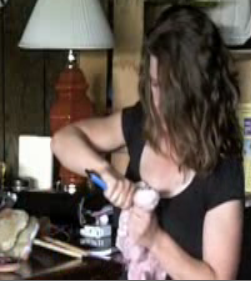
Puppets can be bought from many sources. It is also fun to make your own. There are many types of puppets. Stick puppets can easily be made by upcycling small stuffed animals.
- Choose a stuffed toy (garage sales, parent donations, and second-hand stores are a great source).
- Use scissors or a utility knife to make a small cut in the bottom of the toy.

- Insert a dowel or old wooden spoon (these work great - more surface area inside to stabilize the puppet) in the opening.

- Use hot glue to seal the opening.
- Have fun!
Make Your Own Pointers

Pointers have endless uses in the classroom. They channel student attention, allow teachers to emphasize key skills, promote left to right directionality, and more. Mundane skills like practicing word wall words, reading the room, and reading the morning message are a little more exciting when students have the opportunity to choose a pointer and be the “teacher.” Incorporating positive feelings and utilizing novelty stimulate the brain and serve as a catalyst for learning.

Pointers are available commercially through many educational companies and discount stores. They are also easy to make. Making a special pointer is a fun way to incorporate a theme or highlight a sight word or letter. Wooden dowels can be purchased from discount, craft, or hardware stores. Simply glue an object (such as a foam shape, letter cut-out, spider ring, so on) to the end fo the dowel, and you are ready to roll.

Subscribe to:
Posts (Atom)